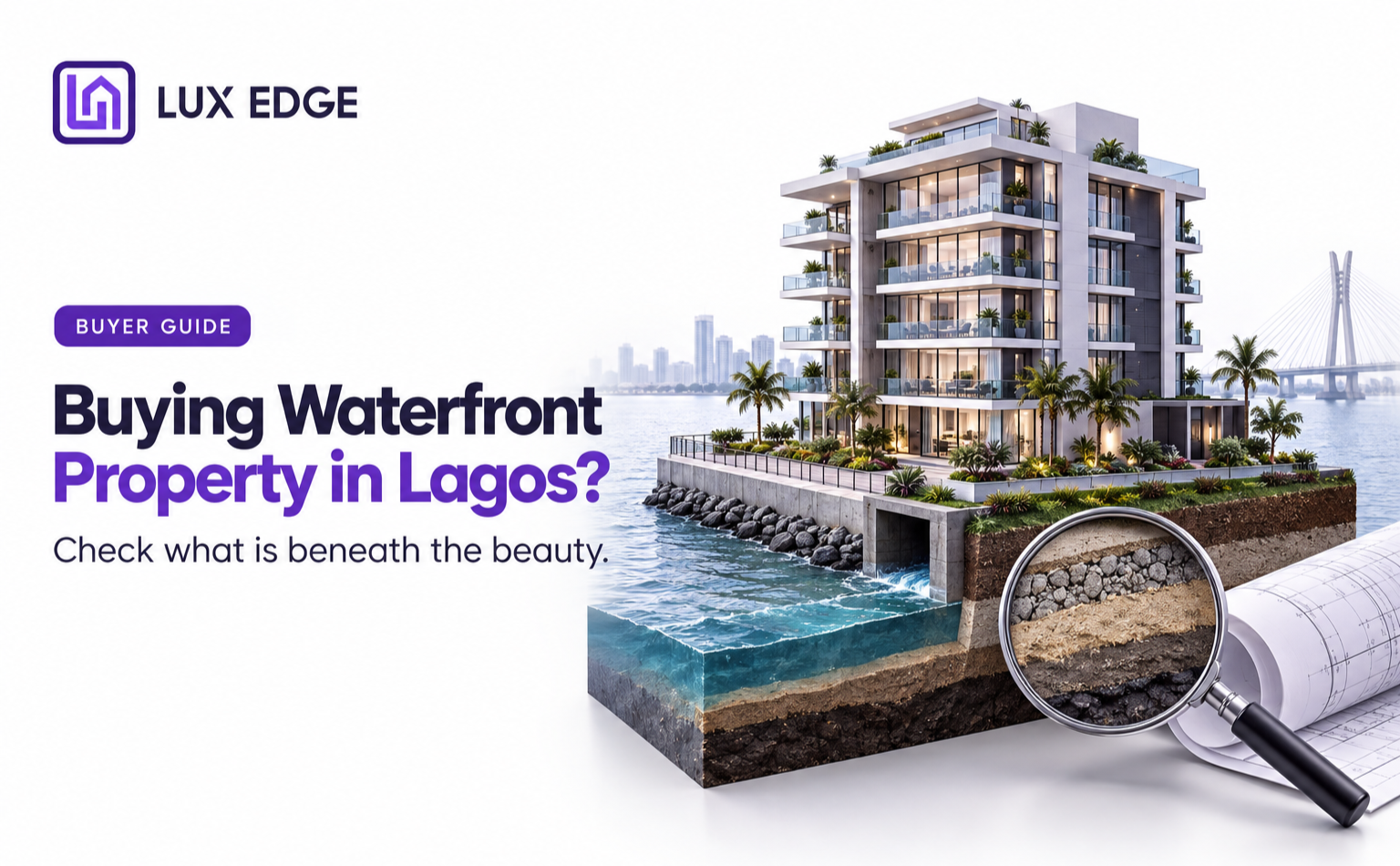
Buying Waterfront Property in Lagos? Check What Is Beneath the Beauty
Waterfront homes carry an obvious appeal. Open views, cooling breezes and a sense of privacy can make an apartment or estate feel exceptional from the first inspection.
In Lagos, however, a buyer should look beyond the view. Some waterside sites are naturally firm, some have been reclaimed, and others sit close to wetlands or drainage routes. Those conditions do not automatically make a property unsafe or unsuitable. They simply make proper investigation more important.
This matters because Lagos continues to expand around its lagoon and coastline. In January 2026, the Associated Press reported on the scale of sand dredging and reclamation around Lagos, alongside concerns about erosion, unstable seabeds and flooding. A Guardian photo essay published in April documented similar concerns in communities including Epe and Oto-Awori. These reports do not assess any particular development, but they are a useful reminder that the land beneath a beautiful building deserves the same attention as the building itself.
If you are buying waterfront or reclaimed-land property in Lagos, especially from outside Nigeria, these eight checks should form part of your due diligence.
1. Establish exactly what kind of land you are buying on
Do not rely on broad descriptions such as “waterfront”, “sand-filled” or “reclaimed”. Ask when the site was filled, where the fill came from, how deep it is and what existed there before development.
Your technical adviser should help you distinguish natural ground from reclaimed land and recent filling from ground that has had time to consolidate. Reclamation can support successful development when it is properly designed and executed. The key issue is whether the developer understood the ground conditions and designed for them.
Ask for a simple written site history. If the answers change between the agent, developer and contractor, pause until the position is clear.
2. Verify the title and the survey coordinates
A waterside address does not answer the ownership question. Instruct an independent property lawyer to review the title, investigate the seller's authority to sell and conduct the appropriate searches.
The survey plan deserves particular attention. Your surveyor should confirm that the coordinates correspond with the actual site and identify any acquisition, right of way, drainage reservation, shoreline restriction or other encumbrance that may affect it.
Do not treat a layout name, estate gate or allocation letter as a complete substitute for title verification. The legal review should cover the precise parcel supporting the development and the interest being transferred to you.
3. Ask for the soil investigation and foundation design basis
The most attractive finishes cannot compensate for a foundation designed without reliable ground information.
For a substantial building, ask whether a geotechnical investigation was carried out. Your structural engineer can review the relevant report, the recommended foundation solution and whether the design responds to the recorded soil layers and groundwater conditions.
You are not expected to interpret borehole logs yourself. The useful question is whether an appropriately qualified professional has reviewed the information and can explain, in plain language, why the chosen foundation is suitable for that site.
4. Compare the approved drawings with what is being sold
Request the planning permit and the approved drawings, then ask a qualified adviser to compare them with the building and the unit described in your offer.
Check the number of floors, use of the building, setbacks, parking arrangement, drainage provisions and the location of the apartment. A general statement that the project is “approved” is not enough if the approved scheme differs materially from the development being marketed.
Lagos State's electronic planning platform provides an official route for planning applications. During construction, the Lagos State Building Control Agency states that its functions include authorisation to commence, stage inspections and completion certification. These are related controls, but they are not the same document.
5. Inspect the drainage route, not only the compound
A clean compound on a dry afternoon tells you very little about how the area performs after heavy rain.
Trace where surface water is expected to go. Look at the road level, neighbouring plots, perimeter drains, discharge points and any pumps required to keep lower areas dry. Ask who maintains the external drainage route and what happens if a public drain is blocked.
Visit after rain where possible. Speak with residents, facility managers and neighbouring occupants. Their accounts are not technical proof, but consistent reports of standing water, inaccessible roads or repeated pumping failures deserve further investigation.
LASBCA's published fitness guidance includes effective drainage of foul water and surface water among the matters relevant to habitability. That makes drainage a liveability issue, not merely a landscaping detail.
6. Review corrosion protection and material choices
Coastal air, salt and moisture can accelerate deterioration. Ask your technical adviser to look at exposed metalwork, balcony railings, external equipment, concrete cover, waterproofing and the protection specified for mechanical and electrical installations.
For an existing building, look for rust staining, peeling coatings, damp patches, cracked sealants and repeated patch repairs. For an off-plan purchase, request the relevant specifications and confirm what maintenance the materials will require.
Premium finishes are valuable, but durability comes from the details that resist water ingress and corrosion over time.
7. Understand the permanent operating cost
Some waterfront developments depend on pumps, water treatment, specialised drainage, shoreline protection or more frequent external maintenance. Those systems can improve reliability, but they also cost money to operate.
Ask for the service charge budget, not only the headline figure. Find out what is included, how electricity for common systems is funded, whether there is a sinking fund and how major repairs will be approved.
For an off-plan scheme, ask for a realistic estimate and the assumptions behind it. For an occupied building, request recent service charge accounts and evidence of maintenance. A home that appears affordable at purchase may become difficult to hold if recurring costs were understated.
8. Match the insurance position to the actual risks
Ask what construction and building insurance exists, who is insured and what events are excluded. Your lawyer or insurance adviser should review the policy rather than relying on a certificate image or a verbal summary.
Insurance does not replace good design, approvals or maintenance. It is another layer of protection, and its value depends on the policy wording, limits, exclusions and compliance with its conditions.
For an apartment, also clarify the boundary between the building's master policy and the cover you may need for your contents, improvements and personal liability.
A practical request list for your adviser
Before paying a substantial deposit, ask your lawyer and technical team to prepare a project-specific review covering:
title and survey verification;
site and reclamation history;
geotechnical information and foundation design;
planning permit and approved drawings;
construction-stage inspection records;
drainage and flood-resilience arrangements;
completion and fitness documentation where the building is finished;
service charge assumptions and insurance.
Not every document will be available in the same form for every property. What matters is that missing information is identified, explained and reflected in your decision and contract.
Waterfront property can still be a sound choice
The lesson is not to avoid every waterfront home. Lagos has high-quality developments in waterside locations, and competent engineers routinely design for difficult ground conditions.
The lesson is to buy with evidence. A good view should come with a clear title, suitable engineering, proper approvals, workable drainage and an operating plan you can afford.
Explore Lux Edge projects in Lekki, or contact our team to arrange an inspection. We encourage every buyer to involve independent legal and technical advisers before committing.
This article provides general information and is not legal, engineering, insurance or investment advice. Requirements should be confirmed for the specific property with the relevant authorities and qualified professionals.